Showing posts with label go green. Show all posts

Friday, December 21, 2012

Waterbank Schools

Kenya's educational system could revolutionize with this new design for their schools. British architects
David Turnbill and Jane Harrison along with Atopia research designed the WATERBANK school in Nigare Nyiro, which mainly harvests water and eventually stores that in a reservoir on the school property. Not only does this ingenious system provide upto five liters per day to each student, it also enables girls normally responsible for collecting water outside of the home to receive education and attend the classes.


The school has four classrooms designed to accommodate upto 60 students. Most of the construction was facilitated from afar and on Skype.This modest school has for 200 schools has been built with locally - sourced materials and by the local community. It has also been encircled by a garden wall designed to keep out thirsty elephants.


The reservoir which is located in the center of the school courtyard stores water-harvested from a catchment system installed on the schools's 600 meter roof. An integrated filtration system ensures that the water is clean and pure. The design team also predicted that depending on the weather, the reservoir could provide upto 350,000 liters of clean water each year.The initiative is produced by PITCHAfrica founded in part by Harrison an Turnbull, who have similar projects  in the works in the same region.


Monday, November 26, 2012

Solar powered floating schools

A non-profit organisation callled shidhulai swanirvar sangstha, has a goal to provide year-round education to Bangladeshi elementary students living in the areas prone to flooding due to monsoons. During rains,hundreds of schools get shut down to their detriment. Due to the torrential downpours,some parts are flooded for 3-4 months in a year, becoming an obstacle for people to continue their education.

Shidulai swanivar sangstha developed solar- powered floating schools to be used during those periods,which travel right up to the mainland to pick-up students. Around 30 students can be accomodated in each boat-cum-classroom and is equipped with an internet-linked laptop, electronic resources, library, providing basic education up to the grade IV level.
With the help of solar energy via panels installed on their rooftops,the computers and overall electricity of the vessels are powered. The use of this sustainable source offers flexible school schedules. After the day is over, students can take home a recharged-low-cost solar lantern, offering them a light source which would help them to continue their studies, while women on the other hand, may continue to stitch quilts after dusk to generate more income for their family.The solar powered lamps are given to families for free providing their children to go to school regularly, and better off households pay only a small monthly fee to receive one of the devices.
Not only for students,but outside elementary school lessons, the boats also act as venues for conducting training sessions for children's parents on such subjects as agriculture, finance, health, hygiene and nutrition.
70,000 children have benefited from this project which was first started in 2002, and is a 2012 WISE (world innovation summit for education) awards winner. It is funded through various resources which includes crops, fisheries as well as conversion of kerosene lanterns into solar ones.Other than education, the venture has also been advantageous in developing solar water farming to safeguard food supplies,improving the nutritional and health status of children,ensuring a year round income for families in flood prone areas.


(Image source: shidhulai.com)

Thursday, November 8, 2012

Concrete that heals itself!


Now here’s an invention that could revolutionise construction technology as we know it and set your home repair requirements back by years! Doesn't that sound like good news all round?

Scientists in the Netherlands claim to have created a bio-concrete blend that allows concrete to …yes! Heal itself! Anybody who’s in the construction industry or has ever tried to repair cracked concrete knows what a nightmare it can be. Dry and cracked concrete can begin to disintegrate and be messy and nearly impossible to repair. Which, of course, is why this new technology is so exciting! 

Inhabitat.com reports that the Dutch scientists have created a bio-concrete blend with built-in bacteria that patch up on small holes and cracks in concrete. The bacteria basically feeds on the food provided in the concrete when activated by water to combine calcium with carbon dioxide and oxygen. What would be the result is essentially limestone.

In order to find bacteria that could survive in the high-pH environment of the concrete mix as well as lie dormant for years, the scientists looked especially in the soda lakes of Russia and Egypt. Fortunately, the bacteria they found were the perfect match.

Meanwhile, researchers at the University of Newcastle in UK have actually created a new type of bacteria that release glue that can mend concrete! There is, however, no news yet on when these bacteria will be ready for commercialization but the hope is it will be sometime soon.

Thursday, September 13, 2012

MIT to the rescue!

The planet is afire. Well, not literally. Not yet, anyway. However, with all the things that are constantly going wrong all over the world, perhaps, that day isn't far. And what we need more than anything else right now is a way to undo things.


In that light this new technique developed by  MIT to magnetically separate oil and water is going to go a long way to help in the cause of our oceans that are suffering from increasing amounts of oil spill every year. The team claims their method to be so efficient that the oil can even be reused after separation. There has, of course, been a good deal of research that has been undertaken in the field before. However, this team contends that while the research so far was good, it would be unlikely to work in situations of oil spills in oceans etc as they fundamentally depend on the concentration of the ferrofluids remaining constant and being known in advance which is likely to differ widely in an oil spill.

The new method developed by the scientists from MIT which uses magnets to separate the ferrofluids, by their contention, sounds much simpler just as its meant to and promises to be a lot more effective. They also contend the method can be implemented on a larger scale and employed at sea for days or weeks even in places where there's no electricity and no maintenance available.

And we can almost hear the oceans sigh in relief. 

Wednesday, September 5, 2012

KEEPING COOL!


If you were to visit this artificial lake in Hanoi, Viet Nam you’d find the stunning structure called Bamboo Wing created by the bamboo masters Vo Trong Nghia. Comprised of two structures one which is the restaurant and the other which is meant to be a bar and events centre, the complex is large and airy and one of their most striking projects to date.

Situated next to an artificial lake the buildings are an excellent example of eco-friendly architecture that showcase the talent and handcrafting skills of the artistes as well as the brilliant use of ecologically sustainable materials. The surrounding water body not only adds a beautiful, mystical element to the structure but also does an excellent job of keeping it cool.

The entrance to Bamboo Wing promises the visitors a scenic experience as they walk across a pathway of stepping stones in water and little pockets of growing bamboo. Bamboo Wing itself is shaped to look like a bird’s wings.

 Next to the Wind and Water Cafe stands the bar. In contrast to the cafe which is open, the bar is an enclosed whole with a dome soaring 10 m upwards with an opening on the top, 1.5 m in diameter, which helps keep the place cool. Aside from the foundation the structure does not use steel anywhere and is wholly made of bamboo.


It’s no surprise that these two stunning architectural structures have become widely famous inHanoi’s urban landscape.

Monday, September 3, 2012

Talk about smooth sailing!


This one’s definitely a step-ahead in design as well as conservation! I wonder if the sailors of yore would have ever thought of seeing their beloved sails put to this use. But today, between Spanish company DVELAS and Spinnaker, the sails return from their maritime journeys to feature in entirely stunning makeovers. Both companies are recycling used sails that have reached the end of their life and putting them into use in a series of innovative furniture designs. The group of architects and designers from DVELAS launched their Living Sails line with the purpose of recovering materials that hold unique histories, and give them a fresh new life through art and expert craftsmanship.

Much like the stylish and extremely comfortable Spinnaker chairs. With a frame made out of spring steel, the chair is ergonomically designed with a curvature that allows for optimum circulation in the body. To add an interesting spin to it Spinnaker encourages people to design and customize their own chairs helping them save on the waste from over manufacturing.


 And the idea has to be applauded for its ingenuity. After all what could be better raw material for all-weather outdoor furniture than sails used by ships. Even once it’s too deteriorated to be used for navigation, the tough, weather-resistant fabric is the perfect material for outdoor furniture.

DVELAS sources its sails from JTX Sails and has launched six different lines of modern outdoor furniture.  Each piece is created from one of many different types of sails, and is accompanied by information on the sail’s history, details on the port and boat it came from, and the name of the original sailmaker. Washed and waterproofed, the fabric still features the marks and designs printed on the original cloth. So you not only have a piece of stylish and comfortable furniture in your house but also a piece of history.

The DVELAS’ website accepts donation of sails, which will be transformed into chairs, cushions, shade structures, and floating rafts.

Tuesday, August 28, 2012

GiraDora and how!


I know from personal experience that washing clothes without a machine is one of the most dreary, time consuming, exhausting and, often likely to be, thankless job ever! So when I read the news of this super cool eco-friendly washer and spin-dyer I just had to talk about it! Created by Alex Cabunoc and Ji A this rather brilliant invention called the GiraDora is powered by a foot pedal!

Priced at $40, the GiraDora looks like an old fashioned ice bucket or water camper or perhaps ice cream maker! All you have to do is fill it with soap and water put the lid on top and then sit on it. Yes, sit on it! And start pedalling! It’s portable so it can be kept anywhere and you can sit on it (I really can’t get over that) and just start pedalling. No more sore backs or cramping legs or wrist strain or anything else! Much like a washing machine the GiraDora can wash loads of clothes at a time. And the amazing little machine dries them too. Now anybody in a family can wash clothes as long as their feet reach the pedal. It saves time, energy, water and your muscles!


Not just that, the machine might well be a source of income through providing laundry services or giving the machine out on rent. It could definitely be a great boon for many, many families, particularly in developing countries and those living in far flung areas and  has been rightly recognised by both the Dell Social Innovation Challenge and the International Design Excellence Awards.

Currently being field tested in Peru there are plans to make the machine available in other parts of the world like South America and India too. 

Monday, August 27, 2012

Green on wheels!


Now this is what we call Smart Greens! Artist Matteo Cibic has come up with a rather clever way to put the green back in the dense concrete jungle that is modern day Milan. In response to Inhabitat Editor, Jill Fehrenbacher’s question posed on Smart Urban Stage – ‘In crowded cities, how do we create better and more public green space to improve quality of life?’ - the artist came up with what is a rather ingenious idea of a ‘tree trolley wifi bench’.

What it is, is a mobile bench and garden combined. So the bench is equipped with wheels and has its own little garden behind it. And not just that, the tree trolley also doubles as a mobile work station for those to enjoy the idea of working outdoors, considering it is wifi enabled and also has charging dockets. And as if that isn't enough, these super functional trolleys will also sport street lights, making the area well-lit and safer giving, in the artists view, a boost to the nightlife of the area.

Making use of the ample parking space around the city, the artist said if people pay to park their cars in front of their homes or work spaces the question is would they pay to park a tree too? It is definitely a greener alternative to automobiles.  

However, what is of immediate though slight concern is all the creepy crawlies the miniature garden will attract. But then, it’s likely every home area will have at least one pair of green thumbs between them!

Friday, June 22, 2012

Fishing for plastic


If you were to be wandering around the Botafogo Beach in Rio around now, don't be surprised to see two giant fish rearing out of the sand and seemingly aiming for the sky.Glittering with the reflection of the sun's rays or if it's a little later in the evening, glowing a warm blue and red (thanks to little LED lights), juxtaposed against the scenic backdrop of Rio's mountains, they might look like something your beauty-drunk brain made up on its own. But they're real, alright. Well, not real fish but real enough otherwise. 


Image by Ascom Riotur
Made out of plastic bottles, these gorgeous fish are not only a spectacular tourist attraction for the duration of the  United Nations Conference of Sustainable Development or the Rio +20. They are also intended to remind us, not least of all, thanks to their sheer size, of the threat of over-consumption of plastic bottles to the planet. Each day human beings around the world use millions of these disposable plastic bottles that are ironically, not disposed of correctly, ending up at land fills instead of being recycled. Unsurprisingly our rivers and oceans are also victims of this over-consumption, directly affecting the marine life which is choking under all this plastic. 

The giant sculptures are meant to impress people, in many ways, of the the threat plastic and our careless attitudes towards its use pose to the ecosystem, and more specifically to marine life. And the bottles used for this are barely an infinitesimal portion of the real problem facing us. 


Wednesday, May 23, 2012

Light and easy!


Keeping it light could acquire a whole new dimension if this newest piece of furniture is anything to go by.
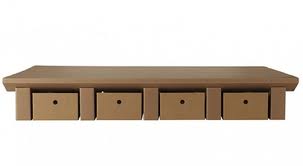
This Paperpedic Bed by Karton is, you guessed it, made of paper. Not only that, this miracle recyclable bed can be turned from a twin bed to a King size one and is claimed to be able to take up to 1 tonne of weight and can comfortably sleep 10 people. Apparently, the company gathered a group of volunteers to test its claim. 


And yes, again, it’s made of paper. Made by a system of intricately folded and tabbed paper panels that come together to form a sleek structure the bed is lightweight, strong and of course, recyclable.

The idea behind Karton’s designing is to create furniture that can be assembled or, rather, unfolded without the need for glue or chasing after extra parts. They wanted their products to be minimalistic, durable and affordable. So their bed retails at about $190 and you can add a set of space-saving drawers that can just slide under the bed at an additional $60 and round it off with a bedside table at about $75.  And voila! You have a whole set of recyclable bedroom furniture at less than $350.

However, if you live anywhere but in Australia you might have a bit of a problem sourcing the company’s furniture for a while yet as it's only available for sale online within Australia. However, the good news is that the company is considering making its furniture available for sale in other countries as well and it might just be possible since they ship all their furniture in compact boxes. Karton also has a variety of other furniture like stools and office furniture that you can consider.

Thursday, May 17, 2012

Nestling in the mountains

Now, who wouldn't want to work in a place like this?


Surrounded by lush alpine greenery in the valley of Saint-Jean-de-Morains between Lyon and Grenoble, this is one corporate office unlike any other you ever saw. The newly constructed office of Rossignol, a leader in the snow sports industry, has been designed and constructed to reflect their technology, commitment to the outdoors, as well as their beautiful, mountainous surroundings. Designed by Herault Arnold Architctes, the structure has been blanketed under one continuous roof that dips, sways and peaks to reflect the mountains around it, with skylights that allow natural light to stream in to rooms.

The skeleton has been built of steel allowing for large, open interior spaces; and then clothed in natural larch wood and grass. The building maximises the use of natural energy by making good use of insulation which prevents the loss of heat. All heat that is wasted is recovered and re-injected into its heating network, and the automatic windows open whenever the conditions outside are just right. Talk about a smart building!


 Inside, the office is the one-stop point for the company, providing for the production of equipment, offices of the management, sales and marketing offices as well as an in-house restaurant very similar to ski lodges.


Now, if you had a place like that to call work, why would you ever want to call in sick?

Wednesday, May 16, 2012

The soul of Seoul!


Kudos, Seoul! This is one architectural work of art that the citizens of Seoul are going to be thanking the civic authorities for, for a long, long time to come.


Seoul restored the lost Cheonggyecheon river which had been buried under asphalt for decades now, turning it into one of the most scenic sites of Seoul. The ChonGae Sunken Stone Garden is located in the Central Business District and was completed in the year 2005. Since then the Garden has seen a footfall of over 10 million which is not surprising in the least bit surprising. Designed by Mikyoung Kim Design, the water levels from season to season allow people to see the status of the river.


For 40 years the stream was covered with a pavement and used as a road. Until they started a project to restore the river and the result was the beautiful urban park it’s turned into today. The Stone Garden is the entry point of the river from where it rises and falls over the sloping and stepped stones. The Garden has, since, become an important place for festivals, concerts and other public events. And we can see why.


Thursday, May 10, 2012

It's all bio!


(picture courtesy inhabitat.com)


This is one home you’re not likely to forget in a hurry. The Villa Bio in Figueres, Spain designed by Cloud9, Barcelona is as eye-catching a home as it is Green. This home has a gorgeous living roof, floor to ceiling glass windows that cap the ends and even an underground parking. 

The entire structure of the house seems to be composed of one ribbon of concrete, slit across the middle and pulled up to make it seem like a split-level. There are also no beams in the house to support the structure, even with the living roof which adds a considerable amount of weight. The living roof at Villa Bio is also designed to support the weight of people lounging in the garden as well as gardening on it. The garden however is a Hydroponic garden which means the garden is planted without the use of soil. 


However, there is the fact that concrete has a rather high carbon footprint. But on the upside it has a remarkably long life and can be recycled. 

Wednesday, May 9, 2012

Just hanging around!

So you fancy yourself a camping enthusiast? Or do you dream of weekends spent outside of four walls and far from the madding crowd?

Well, whatever be your reason for heading out of the city or even your own house, we're sure these tree-hung tents called Tentsile Treehouse Tents would make you very happy!

The tents are meant to be anchored off the ground and mostly, as the name suggests, to be hung between trees when you're living in the wild, much like a hammock. And if there are no trees handy or you just feel the desire or well, the necessity, to sleep out of doors in your backyard, these Tentsile Treehouse Tents also come equipped with three poles you can use to anchor your tent. So, yes, it's a lot like a portable tree house and claims that it'll keep you safe from, well, everything that crawls on the ground, including ground water. For things that can fall off trees ... well, we wish you luck.


The other interesting feature of the tent is that it has compartments and claims to have sleeping room for three people! Well!

Now, as is obvious while the tent is perfect for some situations and you're OK wit jumping out of bed, literally, every morning, we're not sure it's the most ideal thing for every situation.For instance, if your camping trip is an extended one, not having any sort of solid ground under you for such a long time could cause you some back problems. Also, when it rains, only water on the ground would not be your problem. Water could also pool on the tent making things rather uncomfortable.


However, if its camping in the backyard you're looking at, the Tentsile Treehouse Tents sound like a great proposition. 

Tuesday, May 8, 2012

The walls are breathing!


Balcony at Dilston Grove
(copyright Ackroyd & Harvey)


It’s almost literally a temple of green. South East London’s Dilston Grove Art gallery used to once upon a time be a church. And today, it comes fairly close to being something of a living edifice. 

The Italian style church (formerly known as Clare College Mission Church) was the first concrete church to be built in England in the early 1900s. The derelict church has now been converted into an art gallery and boasts of grass walls that cover its interiors, courtesy Ackroyd & Harvey of London.  

Watering Dilston Grove -
(copyright Ackroyd & Harvey)
The austere exteriors of the church gave way to compelling interiors and the artists saw in them the potential to create something that could be a monumental art work. And so came about the grass interiors of Dilston Grove, when vision came together with clay, germinating grass seed, water and natural light; there was almost nothing that stop the creation of this living and breathing, literally, work of art.

Working in conjunction with sound artist and composer, Grame Miller the artists infused life of a unique kind in the decaying interiors of the building over a 3 week period. That it was a breathtaking sight for sore eyes, we have no doubt. Just as we’re sure it brought alive the walls in a way its original architects would never have thought of.   

Monday, April 30, 2012

10 tips to get you started on your Japanese style home


Do you sometimes feel like there’s too much clutter in our day to day lives? There are too many demands, commitments, lists, desires, necessities ... just too much! Do you wish your home would be a haven from these constant demands of the outside world; a place where there’s more space to do, think or just be, and less clutter? Well, you’re not the first. The first person or people who had this idea are probably credited with the creation of the modern style of furnishing.

However, if you’re not one for steel and chrome but still love the clean lines of the modern style then you might want to try going Oriental with your home decorating style. Now, adopting this style in practicality may take a little more research but the basics that you need to get yourself set for a Japanese style home are the following:

1.     As a general rule, stick to neutral colours and soft, natural colours in neutral tones.

2.     Even if you would like to pick one accent colour for your interiors, make sure it’s not an unnaturally bright one. Pick deep brown, turquoise, sort pink or mauve, or even red.

3.     Resist the temptation to turn your walls into collages of every picture you ever took. If you must, pick one accent wall and put up a few pictures in simple frames.

4.     In fact, why just the walls, declutter your house and your lifestyle. Throw out things you don’t or haven’t used in a while or give them to somebody who could use them.

5.     Use light screens of dark wood or bamboo screens to separate spaces.

6.     For your furnishing, pick a low seating arrangement with tables to match. You can even choose to take your seating to the floor but that might be a problem with some of your guests so we’d suggest something that’s between the two.

7.     Invite nature in. It doesn’t necessarily have to be big plants, either. Get a small, flowering plant or even a small plant of dancing bamboos which you can even place on a corner table, or perhaps a small rockery or waterfall in your garden space.

8.     If you’re willing to go as far as relaying a floor, consider getting bamboo flooring. It’s also a very environment-friendly option.

9.     Consider laying down Tatami floor mats to cover the floor.

10.   Use Shoji and Fusuma screens to cover your windows. They not only block out the harsh outside light but also look great.

The basic principle you need to keep in mind when going the Japanese way with your interiors is that Japanese architecture and design works in very close conjunction with nature, both in terms of materials and decor; so keep your spaces open plan and use plenty of glass.
                                                                                                                                                     

Wednesday, April 25, 2012

5 tips for the pocket sized garden


Unfortunately, in today’s Lego block world, garden space is not a luxury most of us can afford. In fact, you’re lucky if you own a patch of grass to call your own. And if you are, in fact, one of these lucky souls, we have just the ideas you need to make that little garden space turn into your personal haven!

1.     A good imagination always helps so that when you look at your little piece of land you don’t extra garbage space but a potential garden.

2.     We really liked the idea of small step gardens. They’re exactly like the terrace gardens you studied about in school, only a lot more compact, and you don’t necessarily have to grown vegetables in it. Plus, they’re expandable and conserve water; just add on another little step whenever you want to add more plants.

3.     Another really great idea is of gutter gardens! No, don’t wrinkle your nose we promise you they’re not disgusting. The idea is to create a long pipe like structure (open from the top, of course) that can be strung along a fence or a wall and grow plants in that. Some people create these “gutters” out of wide bamboo sticks cut across in half.

4
     Another interesting idea would be the one created by Wee Tree landscape designers of Chicago where they place horizontal planters between fence slats, creating a sort of wall of plants.

5.     If what you have in the name of a garden is a square spot of concrete or are not a huge fan of crouching with a spade in your garden, a raised flower bed that stands much like a table on its own four legs is a great idea, looks great and barely takes up any floor space at all!

Tuesday, April 17, 2012

5 Green-ovations you want to look into!


Consider yourself ‘Green inclined’? Do you want your new home or your soon-to-be revamped home to be as Green as possible? Well, then the possibilities of what you can do boggle the mind. And if money’s no object then sky really is the limit as technology comes to your rescue.

Eco-friendly paint for your home has now been around for so long that there's hardly anybody who doesn't know of it. Just as we've all (in the days before eco-friendly paint) walked into a freshly painted space and felt dizzy with the fumes before the tour was even over! And the answer came in the form of Low VOC paints - paints that emit fewer fumes on application and removal, as well as in the years afterwards. For your house exteriors, however, you might want to pick a paint that'll last you longest, since low-maintenance is also Green.

Wanting to bring the sun straight into your home now has new meanings. If you thought solar panels were expensive and too much of an investment for a rented house, these movable solar panels could well be your manna from heaven. Easily installed, you can literally roll these soft solar panels, pick them up and leave the next time you decide to move house.

If you’re so inclined you could also wire your home to a large flat screen monitor that monitors your room-by-room energy consumption helping you identify the areas where you could cut down.

Another fascinating trend is that of modular homes that can literally be packed up and moved with you. What is really interesting about these homes is that their energy-consumption is remarkably lesser considering they can be kept warm or cool as you desire with markedly lesser energy consumption.

If you’re fond of your long hot water showers at the end of the day, you also need to know that every 5-minute shower that you take sends about 80 litres (20 gallons) of water down the drain – literally. That’s enough drinking water for a day for about 20 people. Investing in shower water conservation does sound like a good idea now, doesn’t it? If you scout around in the market you will find ones that suit your requirements the best. We’re sure they’ll prove to be worthy of the investment in the future.

And of course, at the end of the day remember the adage that tells you that there’s nothing Greener than low maintenance. The lesser time, money, energy and resources you have to spend maintaining it the more Green it is!

The Green Ec(h)o!


Eco! It’s nothing if not the new buzzword. It’s the wagon everybody seems to want to jump on to. But eco, like charity, begins at home right? So, what exactly is an eco home, then?

Now, before you picture yourself hitching a bag and heading to the woods or living in a drippy thatch hut in the middle of town with high-end cars and SUVs zipping past or a house with walls of corrugated paper – don’t. All this hue and cry about eco homes is not an underground conspiracy to get you to move into either of those. What an eco home, undoubtedly, is about is an attitude, lots of sensitivity, sprinkled generously with wisdom.

So, basically, whether or not you live in an eco home is really only a reflection of you. Yes, you want every single modern appliance known to man and then some. Yes, you want your home to light up like the Eiffel Tower at the push of a button and for it to be as plush as that of the shahs of Iran. But living luxuriously does not mean you cannot live wisely.

That button which will turn off the light is not, in fact, a mile’s trek from you; use what you need when you need it. Make use of the natural resources available to you. It is, after all, possible for you to harvest rain water and to design your home such that it makes the best of all the natural light and air coming in before you resort to artificial sources. Plant a living or green roof if you can. It'll not be an eye-catching trendsetter, it'll naturally regulate the temperature of your home, all year round! And there, the home you’ve always lived in has now metamorphosed into an eco home!

Remember, an eco consciousness lies in the mind. If you care, it shows and that’s what makes a real difference.