Showing posts with label furnishings. Show all posts

Monday, September 3, 2012

Talk about smooth sailing!


This one’s definitely a step-ahead in design as well as conservation! I wonder if the sailors of yore would have ever thought of seeing their beloved sails put to this use. But today, between Spanish company DVELAS and Spinnaker, the sails return from their maritime journeys to feature in entirely stunning makeovers. Both companies are recycling used sails that have reached the end of their life and putting them into use in a series of innovative furniture designs. The group of architects and designers from DVELAS launched their Living Sails line with the purpose of recovering materials that hold unique histories, and give them a fresh new life through art and expert craftsmanship.

Much like the stylish and extremely comfortable Spinnaker chairs. With a frame made out of spring steel, the chair is ergonomically designed with a curvature that allows for optimum circulation in the body. To add an interesting spin to it Spinnaker encourages people to design and customize their own chairs helping them save on the waste from over manufacturing.


 And the idea has to be applauded for its ingenuity. After all what could be better raw material for all-weather outdoor furniture than sails used by ships. Even once it’s too deteriorated to be used for navigation, the tough, weather-resistant fabric is the perfect material for outdoor furniture.

DVELAS sources its sails from JTX Sails and has launched six different lines of modern outdoor furniture.  Each piece is created from one of many different types of sails, and is accompanied by information on the sail’s history, details on the port and boat it came from, and the name of the original sailmaker. Washed and waterproofed, the fabric still features the marks and designs printed on the original cloth. So you not only have a piece of stylish and comfortable furniture in your house but also a piece of history.

The DVELAS’ website accepts donation of sails, which will be transformed into chairs, cushions, shade structures, and floating rafts.

Saturday, September 1, 2012

Small wonder!

As our number becomes larger spaces available to us become smaller and the challenge today in some of the biggest and busiest cities of the world is to ... well, of course find some kind of space to call your own and then to make the most of what is usually a small space. The challenge, of course, being to not just us the space intelligently but also making sure its well-equipped and presentable.

So coming to the rescue of small-home owners it would seem to IKEA. The Swedish furniture manufacturer is now boasting a new small number on its sign-boards and this time they don't claim them as prices. Advertising their 391 sq. ft. apartments in their Brooklyn stores, their designers have come up with some rather well-designed and assembled living units.

"It might be compact but its more spacious than you can imagine. Its our 391 sq. ft. home" - reads the billboard. And from the images it looks like they're not just boasting. They've managed to carve out quite a decent bit of utility space in their professed 391 sq ft apartments with a bedroom, a bathroom, a kitchen and even a small-sized living room!

And since there's no better way to lead than by example, the little demo spaces they've designed and dressed up at their Brooklyn stores is sure to get plenty of attention as well as give lots of fresh ideas to small apartment owners on what they can do with their living space. And this, of course, will translate into lots of sale for the Swedish furniture manufacturer. Talk about keeping abreast of the times!

Wednesday, May 23, 2012

Light and easy!


Keeping it light could acquire a whole new dimension if this newest piece of furniture is anything to go by.
This Paperpedic Bed by Karton is, you guessed it, made of paper. Not only that, this miracle recyclable bed can be turned from a twin bed to a King size one and is claimed to be able to take up to 1 tonne of weight and can comfortably sleep 10 people. Apparently, the company gathered a group of volunteers to test its claim. 


And yes, again, it’s made of paper. Made by a system of intricately folded and tabbed paper panels that come together to form a sleek structure the bed is lightweight, strong and of course, recyclable.

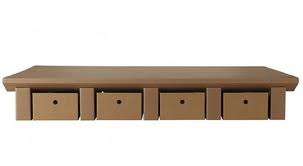
The idea behind Karton’s designing is to create furniture that can be assembled or, rather, unfolded without the need for glue or chasing after extra parts. They wanted their products to be minimalistic, durable and affordable. So their bed retails at about $190 and you can add a set of space-saving drawers that can just slide under the bed at an additional $60 and round it off with a bedside table at about $75.  And voila! You have a whole set of recyclable bedroom furniture at less than $350.

However, if you live anywhere but in Australia you might have a bit of a problem sourcing the company’s furniture for a while yet as it's only available for sale online within Australia. However, the good news is that the company is considering making its furniture available for sale in other countries as well and it might just be possible since they ship all their furniture in compact boxes. Karton also has a variety of other furniture like stools and office furniture that you can consider.

Monday, April 30, 2012

10 tips to get you started on your Japanese style home


Do you sometimes feel like there’s too much clutter in our day to day lives? There are too many demands, commitments, lists, desires, necessities ... just too much! Do you wish your home would be a haven from these constant demands of the outside world; a place where there’s more space to do, think or just be, and less clutter? Well, you’re not the first. The first person or people who had this idea are probably credited with the creation of the modern style of furnishing.

However, if you’re not one for steel and chrome but still love the clean lines of the modern style then you might want to try going Oriental with your home decorating style. Now, adopting this style in practicality may take a little more research but the basics that you need to get yourself set for a Japanese style home are the following:

1.     As a general rule, stick to neutral colours and soft, natural colours in neutral tones.

2.     Even if you would like to pick one accent colour for your interiors, make sure it’s not an unnaturally bright one. Pick deep brown, turquoise, sort pink or mauve, or even red.

3.     Resist the temptation to turn your walls into collages of every picture you ever took. If you must, pick one accent wall and put up a few pictures in simple frames.

4.     In fact, why just the walls, declutter your house and your lifestyle. Throw out things you don’t or haven’t used in a while or give them to somebody who could use them.

5.     Use light screens of dark wood or bamboo screens to separate spaces.

6.     For your furnishing, pick a low seating arrangement with tables to match. You can even choose to take your seating to the floor but that might be a problem with some of your guests so we’d suggest something that’s between the two.

7.     Invite nature in. It doesn’t necessarily have to be big plants, either. Get a small, flowering plant or even a small plant of dancing bamboos which you can even place on a corner table, or perhaps a small rockery or waterfall in your garden space.

8.     If you’re willing to go as far as relaying a floor, consider getting bamboo flooring. It’s also a very environment-friendly option.

9.     Consider laying down Tatami floor mats to cover the floor.

10.   Use Shoji and Fusuma screens to cover your windows. They not only block out the harsh outside light but also look great.

The basic principle you need to keep in mind when going the Japanese way with your interiors is that Japanese architecture and design works in very close conjunction with nature, both in terms of materials and decor; so keep your spaces open plan and use plenty of glass.
                                                                                                                                                     

Thursday, April 26, 2012

Bring India home!


Bring the warmth of India into your home with the use of rich colours and textures. Whether it is your bedroom or the living room, a touch of warmth in a home never goes amiss.


Use warm colours on your walls, or keep your walls in a neutral shade and add a splash of warm colour to your interiors; get a bright rug or frame an antique sari and put it up on the warm. You can also opt for cushions in bright colours on your couches or warm lampshades. Get interesting stone or brass work floor or table lamps to go with these but be careful not to overdo it. Bright draperies can also add life to your room.


Look into other ways you can incorporate stone in your decor, such as marble tables with inlay work from Agra or Rajasthan.


They might be a little expensive but are a real investment. The north-west of the country is also a great place to buy glass from, from colourful traditional hanging-globe lamps or handis to any other artifacts.


The south of the country is a great place to buy brass work and wood works from, while the North is a great place to source all your carvings. Head to the  North east for warm rugs and interesting bamboo works etc. 

The really great thing about Indian decor is the vast variety that’s available to you to work with thanks to the sheer diversity of the country.

So go ahead, bring some India into your homes!

Wednesday, April 25, 2012

5 tips for the pocket sized garden


Unfortunately, in today’s Lego block world, garden space is not a luxury most of us can afford. In fact, you’re lucky if you own a patch of grass to call your own. And if you are, in fact, one of these lucky souls, we have just the ideas you need to make that little garden space turn into your personal haven!

1.     A good imagination always helps so that when you look at your little piece of land you don’t extra garbage space but a potential garden.

2.     We really liked the idea of small step gardens. They’re exactly like the terrace gardens you studied about in school, only a lot more compact, and you don’t necessarily have to grown vegetables in it. Plus, they’re expandable and conserve water; just add on another little step whenever you want to add more plants.

3.     Another really great idea is of gutter gardens! No, don’t wrinkle your nose we promise you they’re not disgusting. The idea is to create a long pipe like structure (open from the top, of course) that can be strung along a fence or a wall and grow plants in that. Some people create these “gutters” out of wide bamboo sticks cut across in half.

4
     Another interesting idea would be the one created by Wee Tree landscape designers of Chicago where they place horizontal planters between fence slats, creating a sort of wall of plants.

5.     If what you have in the name of a garden is a square spot of concrete or are not a huge fan of crouching with a spade in your garden, a raised flower bed that stands much like a table on its own four legs is a great idea, looks great and barely takes up any floor space at all!

Monday, April 23, 2012

Low Cost Housing


Low cost housing seems to be the buzzword in today's news. The Government commits to it, companies want the contract to it, people are skeptical about it ... but whatever it is, it's in the news. So, what exactly does low cost housing entail? 

Apparently, low cost housing or LCH as it's also known, is not necessarily synonymous with low-grade products or the use of untrustworthy material. Low Cost Housing includes effective budgeting, use of local resources and improved skills and technology that eventually reduce the overall cost of construction of the project without sacrificing the eventual strength of the structure.So, essentially, LCH is about the economic management of resources, making the eventual product more affordable for all classes of society.

The cost of constructing a building can essentially be divided into two heads:
Building material cost
Labour cost 

In LCH the cost of building material is reduced because of the use of the locally available materials that are efficient and by an improved design. Labour cost can be reduced by making a disciplined schedule of work. 

Other methods that are used to reduce costs are
1) By reducing plinth area by using the thinner wall concept, like a15 cms thick solid concrete block wall.

2) Use of locally available material in an innovative form like soil cement blocks in place of burnt brick.

3) Use of energy efficiency materials

4) Use environmentally friendly materials which are substitute for conventional building components, like, R.C.C. Door and window frames in place of wooden frames.

5) Every component of a house is pre-planned and the design procedure rationalised with a view to reduce the size of the component in the building. This also curtails the wastage of materials.

6) The re-creation of the same design also goes a long way in bringing down costs.

Wednesday, April 18, 2012

Furniture Time Travel: A touch of French romance


Ever wondered what is with the French cabinet-makers and the hullabaloo regarding Louis XVI tables? Well, here’s your quick guide to decoding the basics of French furniture history and perhaps, bringing some of that romance home.

French furniture has a history that’s as rich as the nation as itself. From the Middle Ages when the furniture was largely improvised to the famous pieces created during the time of Louis VI and then Napoleon, it’s had a long and eventful journey.

It might have taken a century for France to come in contact with the Italian Renaissance but once it did, its effects were to be seen everywhere. Cabinets became chests, chairs were padded, and tables became highly sculpted. During the reign of Louis XIII, the French furniture-makers discovered bead and spiral turning, perfected veneering and began working with metal.

Marie-Antoinette's bureau-plat
However, the reign of Louis XIV saw the beginning of the golden era of French making that the world would remember for a long, long time to come. Versailles was in all its glory with its best cabinet-makers and decorators in attendance. The commode or chest of drawers appeared with ornate brass pulls and key escutcheons. Tables began to be designed for more specific functions such as gaming and writing, and drawers were introduced in the band just below the top which was covered in something other than simple hardwood so as to be more friendly to the quill and the bureau-plat was born. At the same time legs became more figural. Faces of gods, bearded fauns, arabesques, nymphs, goddesses, allegories, cornucopia, and foliage abounded as did the sun, which was the royal emblem. The wood used was pear, walnut, natural woods and imported ebony and other precious woods. Gilded bronze decorations were very popular. Copper, pewter, silver, tortoiseshell, mother-of-pearl was found in the marquetry which basically means inlay work.

A slow transition from thereon saw the emergence of asymmetry in the times of Louis XV; just as the taste for secrecy pervading the French society resulted in a profusion of hiding places that opened with springs.

The reign of Louis XVI saw the discovery of the city of Pompeii and a resurgence of interest in all things Roman. This style is also known as the Neo Classical style. Furniture became simpler and less ornate. Furniture legs became straight and the backs of chairs became oval, rectangular or shield-like.  Designs became more simplified. Marquetry was abandoned in favour of more austere decorations. Geometric patterns were still prevalent but less extravagant than before. Greek ornamental designs became popular, like the sphynx, gryphon, and the Grecian urn. Egyptian motifs also emerged.

This love for Egyptian motifs continued into the Empire period when Napoleon ruled over France. They were seen gracing several marble tops, as were the Napoleonic symbols of the eagle and the prolific N which stood for Napoleon. Unlike the preceding styles it relied heavily on shiny veneer rather than wood carving and relied on size to convey its intentions.